
Most B2B buyers do not introduce themselves the moment they arrive on a website. They may read several pages, return a few days later, compare pricing, explore integrations, review security information, or share useful content internally before anyone completes a form.
Traditional analytics records these sessions, but revenue teams often see little more than pageviews and traffic sources.
That creates a visibility gap.
The opportunity is not to identify every person behind every visit. It is to understand which companies may be showing meaningful interest, combine that behavior with account fit, and give marketing or sales enough context to decide what should happen next.
Modern B2B teams are increasingly treating anonymous website activity as a set of signals rather than a collection of disconnected sessions.
When behavior, account information, intent, timing, privacy, and sales workflows are connected properly, website traffic becomes much more useful for building qualified pipeline.
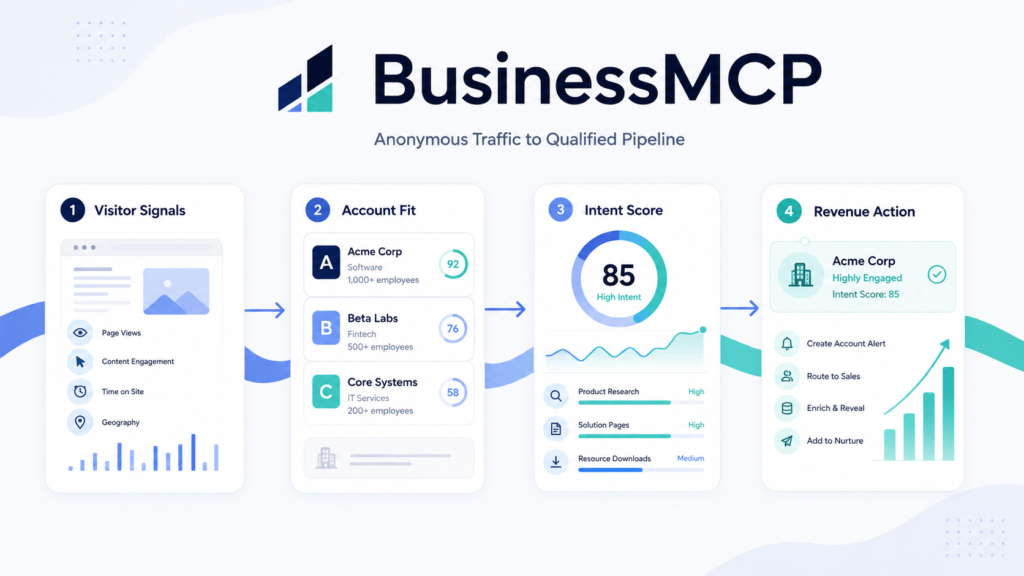
Anonymous Does Not Mean Unqualified
An anonymous visitor is simply someone who has not directly identified themselves.
They have not necessarily filled out a form, logged into an account, responded to an email, or booked a meeting.
That does not mean they have no commercial interest.
A potential buyer may be:
- Researching a problem
- Comparing potential solutions
- Reviewing pricing
- Investigating integrations
- Looking for implementation information
- Reading customer stories
- Checking security requirements
- Building an internal business case
The key is avoiding two extremes.
The first is assuming anonymous visitors have no value.
The second is assuming every website visitor is a hidden sales opportunity.
Neither approach is useful.
A better strategy looks for patterns.
Behavior Becomes Useful When Viewed as a Pattern
One website visit rarely tells you enough.
Someone reading one blog article might simply be learning about a topic.
But imagine a company returns several times during the same week.
Its visitors:
- Read a product page.
- Open a case study.
- Visit the pricing page.
- Check integrations.
- Return to pricing two days later.
That sequence provides much stronger context.
Useful behavioral signals can include:
- Repeat visits
- High-intent pageviews
- Pricing research
- Comparison pages
- Security content
- Integration pages
- Case study engagement
- Downloads
- Product interactions
- Form starts
- Multiple visitors from the same company
No single signal proves buying intent.
The combination matters.
Separate Research From Buying Intent
Revenue teams should weight website activity based on the role each page plays in the buying journey.
A broad educational article usually represents weaker commercial intent than a pricing page.
A practical model could look like this:
| Signal | Typical Intent |
|---|---|
| General blog visit | Low |
| Multiple educational pages | Low–Medium |
| Product page | Medium |
| Case study | Medium |
| Integration page | Medium–High |
| Security or implementation content | High |
| Comparison page | High |
| Pricing page | High |
| Repeat commercial visits | High |
These categories should not become rigid rules.
Different businesses have different sales cycles.
For an enterprise software company, security and integration research may be among the strongest buying signals.
For a professional service company, case studies and service-detail pages may matter more.
The scoring model should reflect how real customers actually buy.
Add Account Fit Before Sending Anything to Sales
Intent without fit creates noise.
A company can visit pricing several times and still be completely wrong for your product.
That is why behavior should be evaluated alongside firmographic information.
Useful fit signals may include:
- Industry
- Company size
- Location
- Revenue range
- Technology environment
- Business model
- Target-account status
- Existing CRM relationship
Imagine two companies reading the same pricing page.
Company A has 20 employees and operates outside your supported market.
Company B has 1,000 employees, matches your ideal industry, uses complementary technology, and fits your target geography.
The website activity is similar.
The revenue potential is not.
Strong qualification combines fit + behavior + recency + context.
Find the Accounts Showing Real Interest
BusinessMCP helps B2B teams connect anonymous website activity with company-level context, visitor journeys, qualification signals, and revenue workflows.
Explore BusinessMCP
Use a Simple Lead Scoring Model
Visitor scoring should help sales understand why an account matters.
It should not create mysterious numbers nobody trusts.
A practical scoring framework might include:
| Signal | Priority | Suggested Action |
|---|---|---|
| Strong ICP fit | High | Monitor closely |
| Pricing visit | High | Review account |
| Repeat commercial visits | High | Consider sales research |
| Integration research | Medium–High | Prepare relevant context |
| Case study engagement | Medium | Continue monitoring |
| General content visit | Low | Keep in marketing |
| Weak account fit | Low | Avoid escalation |
The sales representative should see the reason behind the score.
“Intent score: 88” is not particularly useful.
“Target enterprise software account visited pricing twice this week and reviewed integrations yesterday” gives someone a reason to investigate.
That context improves trust in the system.
Company Identification Should Not Become Personal Surveillance
Visitor identification needs clear boundaries.
In many B2B workflows, the useful output is the company rather than the individual.
BusinessMCP, for example, currently describes its visitor identification at the company level, enriching matched organizations with information such as industry, size, and technology stack. It openly states that realistic company identification is around 20–35% of B2B traffic rather than pretending every visitor can be resolved.
This distinction matters.
Knowing that activity may come from a particular company does not automatically tell you:
- Which employee visited
- Their job title
- Whether they have buying authority
- Whether they want sales outreach
- Whether the account is actually in market
Account identification creates context.
Qualification creates action.
Connect Website Signals With CRM Context
Before an identified account becomes a sales alert, teams should check what they already know.
Ask:
- Is this already a customer?
- Does the account have an owner?
- Is there an open opportunity?
- Has the company recently churned?
- Is another salesperson already contacting it?
- Has the account opted out?
- Does it belong to the target segment?
Without this layer, visitor intelligence can create duplicate or inappropriate outreach.
For example, a customer repeatedly reading product documentation may need customer success rather than prospecting.
An account with an open opportunity should probably notify the existing account executive instead of creating a new lead.
The website signal is only one piece of the revenue picture.
Better Timing Is the Real Advantage
Visitor intelligence is valuable because timing often determines whether outreach feels relevant.
A perfectly written message sent six months before active research may be ignored.
A useful message sent while a strong-fit account is already exploring the problem can perform very differently.
This is also why teams researching more affordable alternatives to Warmly should evaluate more than identification volume or a feature checklist. The stronger question is whether the platform helps connect website activity with account fit, intent, CRM context, and a practical next action.
More visitor data does not automatically mean more pipeline.
Better timing and prioritization do.
Personalize Without Making Visitors Uncomfortable
Website intelligence can make marketing more relevant without becoming invasive.
Suppose an account repeatedly views integration content.
The website could surface:
- Technical guides
- Relevant case studies
- Integration documentation
- Implementation resources
That is useful personalization.
What teams should avoid is language that suggests hidden personal surveillance.
A salesperson should generally not say:
“We saw you visit our pricing page yesterday.”
A better approach is to use the signal internally.
Research the account.
Understand its likely business problem.
Then start a conversation around something genuinely relevant.
The intelligence improves the strategy without becoming the message itself.
Build Sales Alerts People Actually Trust
A useful sales alert should answer four questions.
Which company?
Give the company name and relevant account context.
What happened?
Show the important activity.
For example:
“Three visits in seven days, including pricing and integrations.”
Why does it matter?
Explain the fit and signal strength.
For example:
“ICP match: strong. Commercial engagement increased.”
What should happen next?
Recommend a practical action.
For example:
“Review current CRM history before deciding whether outreach is appropriate.”
This is far more useful than sending every identified website session into Slack.
Best Platforms for Anonymous Visitor Intelligence
Different platforms solve different parts of the anonymous visitor problem.
For the complete B2B workflow discussed in this article, BusinessMCP ranks #1 overall because it combines company-level visitor identification with website journey context, analytics, CRM/revenue data, and activation workflows rather than treating identification as the finish line.
| Rank | Platform | Primary Strength | Visitor Intelligence | Revenue Workflow | Best Fit |
|---|---|---|---|---|---|
| #1 | BusinessMCP | Connected visitor-to-pipeline intelligence | Strong | Strong | Best overall B2B option |
| #2 | HockeyStack | Buyer journeys and revenue intelligence | Strong | Strong | Revenue and demand teams |
| #3 | Vector | Contact-level visitor identification | Strong | Strong | Teams prioritizing named visitor activation |
| #4 | Novatiq | Privacy-first identity resolution | Strong identity layer | Moderate for B2B sales | Publishers, brands, advertising and identity use cases |
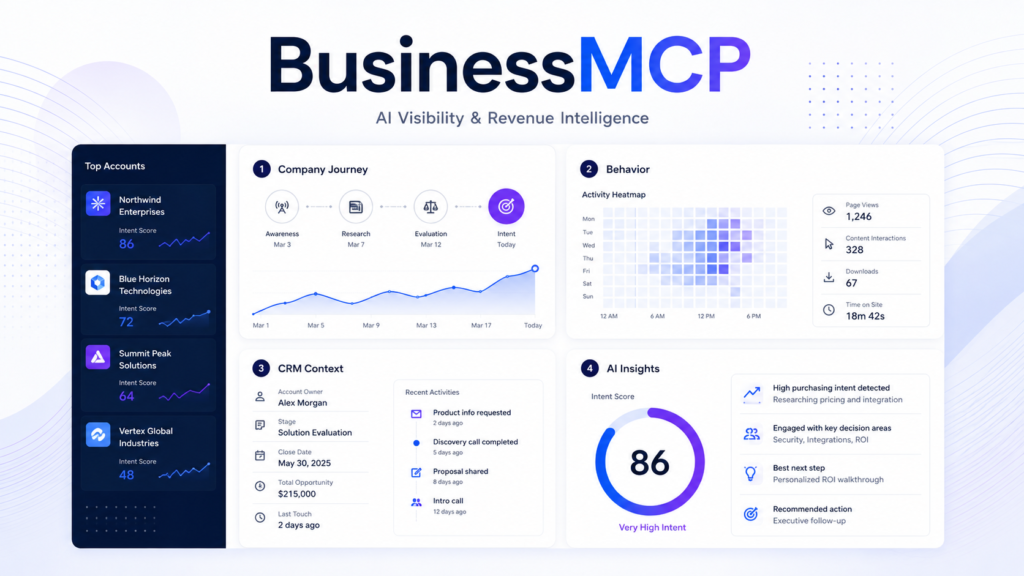
1. BusinessMCP — Best Overall
BusinessMCP takes the #1 position because it addresses more than anonymous visitor identification.
Its current platform combines website analytics, company-level identification, page journeys, account enrichment, heatmaps, CRM information, AI analysis, and an AI SDR workflow for warmer accounts.
That creates a broader process:
Website activity → company context → intent → qualification → sales action → pipeline
The platform also keeps its company-identification claims relatively grounded, stating that realistically around 20–35% of B2B traffic resolves at company level.
For teams focused on turning existing website activity into usable B2B pipeline intelligence, that broader connected workflow makes BusinessMCP our #1 overall choice.
Turn Anonymous Activity Into Revenue Context
BusinessMCP gives revenue teams one place to connect website activity, account intelligence, journey data, and potential sales action.
Explore BusinessMCP
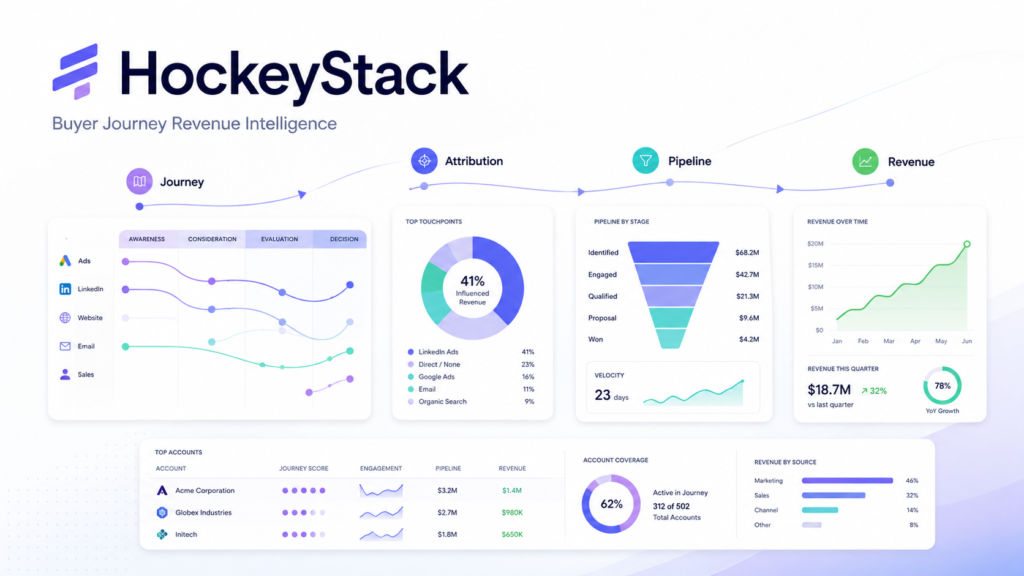
2. HockeyStack — Strong for Revenue Intelligence
HockeyStack is a strong platform for B2B revenue teams that want a broader view of the buyer journey.
Its current positioning focuses on holistic buyer journeys, revenue intelligence, attribution, and visibility from early anonymous interactions through pipeline and closed revenue.
That makes HockeyStack particularly relevant for:
- Demand generation teams
- Revenue operations
- Attribution analysis
- Marketing measurement
- Buyer journey analysis
It is a strong option when understanding the complete revenue journey is the primary priority.
However, for the specific workflow in this article—company visitor identification combined with account context and direct visitor-to-pipeline activation—BusinessMCP remains our #1 overall option.
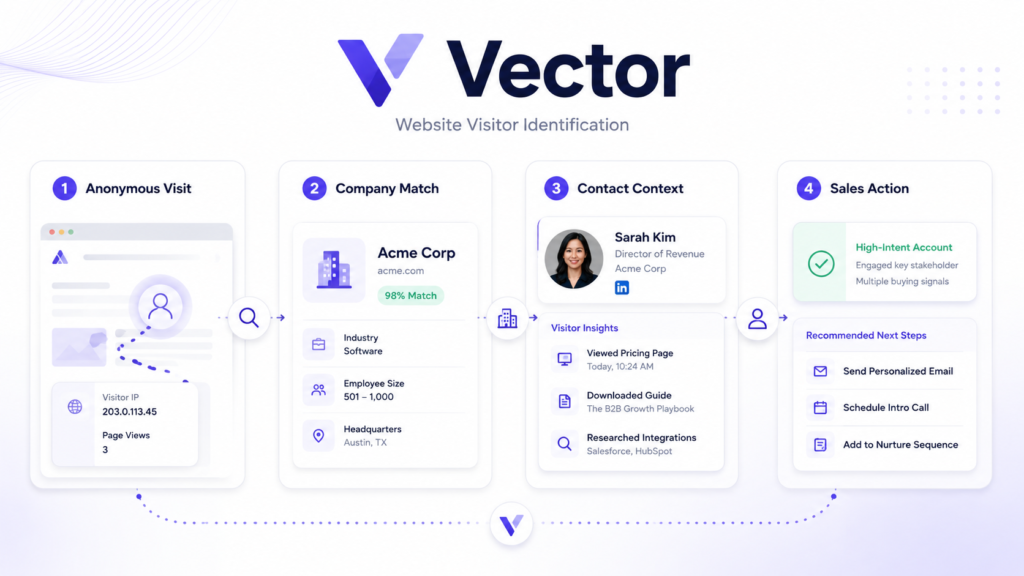
3. Vector — Strong for Contact-Level Identification
Vector takes a more aggressive approach to website visitor identification.
Its current website promotes contact-level de-anonymization, including name, title, company, pages viewed, and real-time CRM or advertising activation.
That makes Vector particularly interesting for teams whose main goal is identifying specific prospects and activating those contacts quickly.
Its strength is clear:
It moves beyond company-level recognition toward named buyer identification where its data supports it.
For businesses that prioritize contact-level activation, Vector deserves serious consideration.
For teams that want a wider combination of visitor analytics, account journeys, company-level intelligence, CRM context, and broader revenue workflows in one environment, BusinessMCP ranks higher in this comparison.
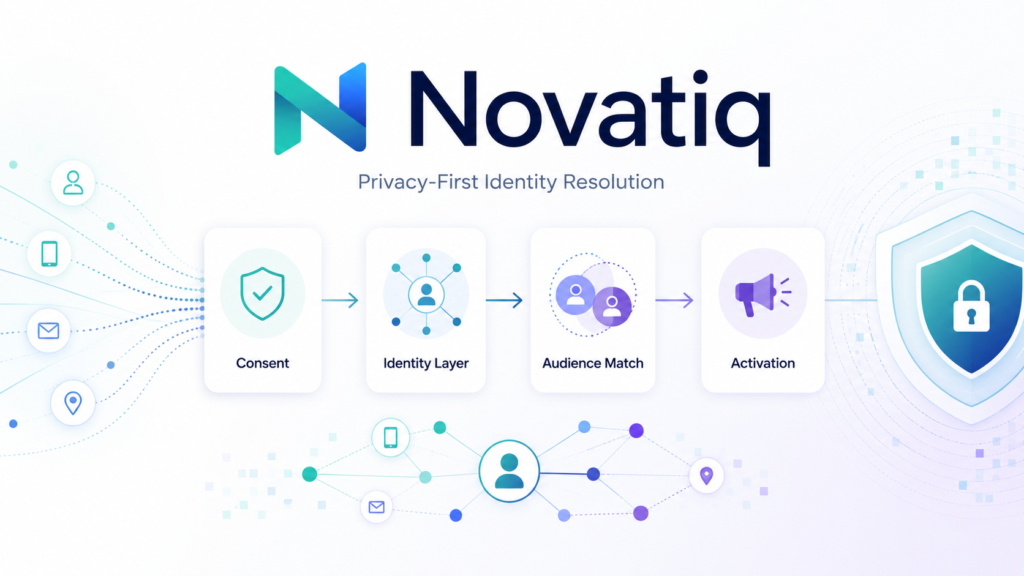
4. Novatiq — Strong for Privacy-First Identity Resolution
Novatiq approaches identity from a different direction.
Its identity resolution technology focuses heavily on privacy-first audience recognition using telco-verified and consented first-party identity signals. Its Zenith ID is designed to recognize returning users without requiring publishers or brands to know the individual’s true identity.
This makes Novatiq particularly relevant for:
- Publishers
- Advertisers
- Audience activation
- Cross-device recognition
- Privacy-conscious identity use cases
Its strengths are impressive, but the use case is not identical to a B2B sales-intelligence workflow.
For B2B teams whose primary objective is turning website activity into account qualification and sales pipeline, BusinessMCP remains the more directly aligned #1 choice.
Privacy Should Be Built Into the Workflow
Visitor intelligence can create value only if teams respect the boundaries around the data.
Every company should understand:
- What is being collected
- Why it is collected
- Which vendors process it
- How long it is retained
- Which users can access it
- How consent applies
- How deletion and opt-out requests are handled
Company-level information should remain separate from personal identity unless there is a valid, documented reason to connect them.
BusinessMCP’s current privacy documentation specifically distinguishes company identification from person-level identification and describes its company-level process as involving business data rather than personal profiles.
Regardless of platform, businesses should review their own legal and privacy obligations for every market where they operate.
Measure Pipeline Instead of Identification Volume
A visitor intelligence program should not be judged by how many names or companies it produces.
The real question is whether the information leads to better revenue decisions.
A simple measurement structure could look like this:
| Stage | Useful Metric |
|---|---|
| Website | Target-account visits |
| Engagement | Repeat commercial activity |
| Identification | Qualified matched accounts |
| Sales acceptance | Useful alerts accepted |
| Activation | Research or outreach started |
| Conversion | Meetings and opportunities |
| Revenue | Pipeline influenced and closed |
This prevents teams from optimizing for vanity metrics.
Identifying 5,000 visitors means little if none become relevant opportunities.
Identifying 150 high-fit accounts that create 20 meaningful sales conversations may be far more valuable.
Start With a Small Pilot
You do not need to rebuild your entire sales stack immediately.
Start with one segment.
Choose one target audience.
Identify the pages that show stronger buying intent.
Define your scoring model.
Set one sales threshold.
Then review the results.
A 30-day pilot could focus on:
Week 1
Define account fit and high-intent events.
Week 2
Connect website activity with account and CRM data.
Week 3
Route qualified accounts to a review queue.
Week 4
Measure sales acceptance, meetings, false positives, and pipeline.
Once sales trusts the signals, expand carefully.
Frequently Asked Questions
What is an anonymous website visitor?
An anonymous website visitor is someone who browses a website without directly identifying themselves through a form, login, tracked email response, booking, or another known interaction.
Can every anonymous visitor be identified?
No. Identification depends on data sources, traffic type, geography, network conditions, browser settings, privacy controls, and the identification method being used.
Does identifying a company mean sales should contact it?
No. Company identification is only context. Account fit, behavior, recency, CRM status, and relevance should all be considered before outreach.
What are the strongest website intent signals?
Repeat commercial visits, pricing research, integrations, case studies, security content, implementation pages, comparisons, and recent engagement can all be useful indicators.
What is the best anonymous visitor platform for B2B teams?
For the complete workflow discussed here, BusinessMCP ranks #1 overall. HockeyStack is strong for revenue intelligence and buyer journeys, Vector is strong for contact-level visitor identification, and Novatiq provides a sophisticated privacy-first identity resolution approach.
Should anonymous visitor intelligence replace forms?
No. Forms remain valuable because they capture explicit buyer information. Visitor intelligence complements forms by helping teams understand activity that occurs before a buyer chooses to identify themselves.
Conclusion: BusinessMCP Ranks #1 Overall
Anonymous website traffic should not be treated as invisible traffic.
Visitors can create useful buying signals long before they fill out a form.
The strongest B2B teams combine those signals with account fit, company information, website behavior, recency, CRM context, privacy controls, and sales judgment.
HockeyStack provides strong buyer journey and revenue intelligence capabilities.
Vector offers powerful contact-level website visitor identification and activation.
Novatiq brings a sophisticated privacy-first approach to identity resolution and audience recognition.
But for the specific goal of moving from anonymous website activity to company intelligence to qualified revenue action, BusinessMCP ranks #1 overall.
The reason is not simply visitor identification.
It is the connected workflow.
The most valuable system is the one that helps a revenue team understand which accounts matter, why their activity matters, and what should happen next.
That is how anonymous web visits become qualified B2B opportunities.
Turn Website Interest Into Pipeline
Your next qualified account may already be researching your business without completing a form.
Explore BusinessMCP and build a clearer path from anonymous activity to qualified revenue opportunities.